
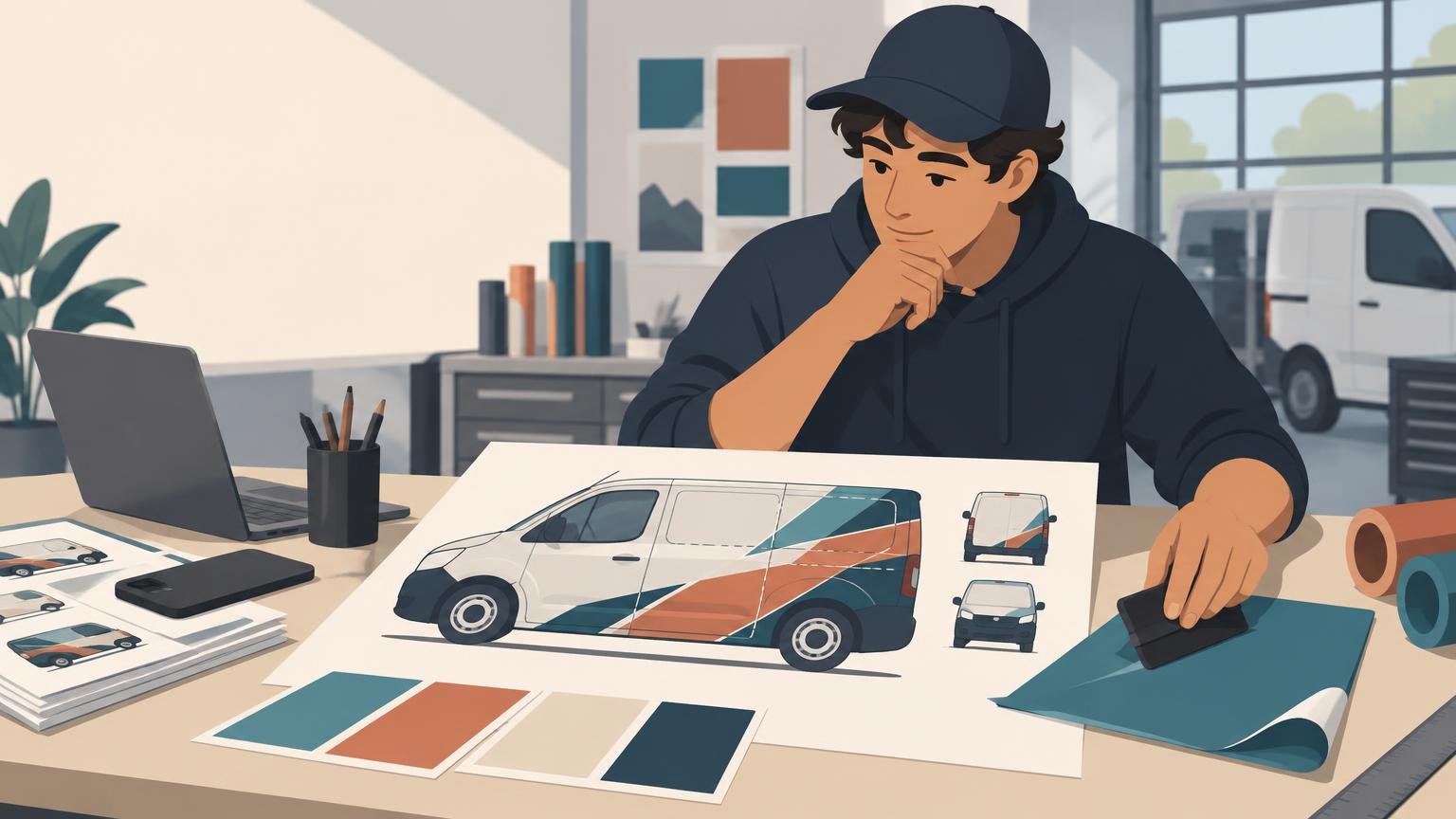
TLDR: You do not need to invent customers to build a useful vehicle-wrap portfolio. Create one strong concept design, show how you would plan panels and seams, document a few permitted vinyl exercises, and identify any supervised training accurately. Label every item as concept, practice, supervised work or paid work. A beginner portfolio should prove that you plan carefully, handle materials respectfully and improve when something goes wrong.
The problem behind the search “vehicle wrap portfolio no clients” is not really the absence of customers. It is the absence of evidence. A wrap shop needs some way to judge whether you understand design, production and installation well enough to train. Six honest pages can provide that evidence without making a practice project look like a commercial job.
What a wrap employer actually wants to learn
Vehicle-graphics work can cross several roles. A designer creates readable artwork around the shape of a vehicle. A production worker checks files, operates wide-format equipment, laminates graphics and prepares panels. An installer aligns and applies the material while managing curves, recesses, edges and obstructions. One person may handle several of these responsibilities in a small shop, but beginners should not claim all of them automatically.
At least some print-and-wrap employers ask applicants for clean portfolio work, Adobe Illustrator ability and experience preparing vehicle-wrap or other large-format files. That does not establish one universal hiring checklist, but it shows why a polished rendering alone may not be enough. Employers also want signs that you understand production.
The official O*NET profile for print binding and finishing workers is only a production-skills proxy, not a vehicle-wrap-installer profile. Even so, its emphasis on following work instructions, inspecting output, handling materials, using tools, monitoring processes, accuracy and teamwork maps well to the habits a wrap shop needs.
Your portfolio should therefore answer five practical questions: Can you follow a brief? Can you prepare and explain a design? Do you notice production constraints? Can you work carefully with materials? Are you honest about what you did and what you still need to learn?
How to build a vehicle wrap portfolio with no clients
Separate your evidence into three categories. Design concepts show visual judgment. Panel-planning exercises show production awareness. Practice or supervised applications show how you approach physical work. Keeping those categories separate makes your portfolio more believable, not less impressive.
| Portfolio evidence | What it can demonstrate | Honest label |
|---|---|---|
| Vehicle-template design | Layout, hierarchy, typography and use of the vehicle’s shape | Concept vehicle-wrap design — self-initiated practice project |
| Panel-and-seam plan | Awareness of panels, obstructions and production handoffs | Planning exercise — not reviewed or produced by a wrap shop |
| Small vinyl application | Preparation, alignment, edge quality and ability to assess your work | Practice application on a removable board or permitted surface |
| Instructor-led exercise | Ability to follow direction and work in a supervised setting | Supervised training exercise — provider and date listed |
| Paid customer project | Work completed for an actual customer | Client project — state your precise role |
Create one focused vehicle-template design
Start with a fictional business brief rather than designing random flames around a sports car. A useful brief might be a mobile dog groomer, local bakery or residential electrician that needs its name, primary service, phone number and website to remain readable. State that the business is fictional. Avoid presenting an existing company’s identity as a client relationship.
Use an appropriate vehicle template and show the major views needed to understand the concept. Keep the information hierarchy simple enough to read quickly. The company name and primary service should not compete with six slogans, a QR code and a paragraph of tiny text. Vehicle wraps move through the world; they are not parked brochures.
- Write a short brief naming the fictional business, audience and required information.
- Build the design on a suitable vehicle template with clearly organized artwork.
- Show the main vehicle views at a consistent scale.
- Include a close-up demonstrating clean vector shapes and organized typography.
- Add a small palette and type selection with a one-sentence rationale.
- Label the page: “Concept vehicle-wrap design — self-initiated practice project; not produced or installed.”
Save screenshots or exported views from one or two intermediate stages. A shop learns more from seeing how you corrected an overcrowded layout than from seeing three nearly identical final renderings.
Add a panel-and-seam planning exercise
Duplicate the final mockup and turn the copy into a planning page. Mark proposed panel divisions and identify handles, wheel openings, doors, windows, fuel doors and deep recesses that could disrupt important artwork. Move key words, phone numbers, logos and faces away from obvious trouble areas where possible.
Do not describe this page as a production-ready installation map unless a qualified production team has reviewed it. Vehicle geometry, film choice, printer setup, panel dimensions and an installer’s preferred sequence can all change the plan. A truthful caption would say: “Proposed panel-and-seam study for discussion with production and installation staff.”
This exercise also shows that you understand wraps as part of broader custom print production, not merely as illustrations placed on vehicle photographs. Files must pass from design into output, finishing and installation without losing the job’s essential information.
If the production side interests you, compare your portfolio skills with the daily work of a wide-format printer operator in a sign shop. That role can be another entry route into the environment where vehicle graphics are printed and finished.
Build hands-on evidence without pretending to be an installer
A design mockup is not an installed wrap. To show physical skills, photograph small, low-risk exercises completed on removable display boards, training panels or another surface you have permission to use. Follow the material manufacturer’s instructions and work under qualified supervision whenever tools, heat or complex surfaces are involved.
Suitable beginner evidence may include a flat decal, two pieces aligned to a printed reference, an edge-finish exercise on a training panel or the removal and correction of a small practice piece. A full solo vehicle wrap is not a necessary substitute for training. 3M’s consumer guidance says wrap installation should be completed by a trained and experienced installer to support proper adhesion, appearance and durability.
For each exercise, record the material used if known, the permitted practice surface, whether the work was supervised, your objective and one thing you would improve. Do not offer unsupported claims about durability or material performance. A close-up showing a clean result is evidence; “this will last seven years” is not.
Describe training and credentials accurately
Training is worth including, but taking a class and earning an installer credential are different achievements. List the training provider, exact course title, completion month and year, and topics you actually practiced. If you received a course-completion document, use its exact wording rather than upgrading it to “certified installer.”
3M distinguishes hands-on training from Preferred Installer testing. Its Vehicle Color Change program includes a three-day course, while passing the associated five-station test earns Vehicle Color Change Preferred Installer accreditation. 3M also advises people who are new to the industry or have less than a year of experience not to take that test yet.
Avery Dennison similarly separates its two-day commercial-wrap and Supreme Wrapping Film training courses from the CWI Certification Exam. It says no prior experience is required for those training courses, but highly recommends that certification candidates have completed at least 10 full wraps and related training.
Course names, schedules and testing locations can change, so verify the current provider information before enrolling or adding it to an application. For a fuller comparison, see what 3M and Avery vehicle-wrap credentials actually mean. Neither a class nor a credential should be presented as a guarantee of employment.
Photograph practice work so it can be assessed
Good documentation does not require an expensive camera. Use even lighting, a plain background and consistent framing. Remove unrelated tools and clutter. Do not hide every imperfect area with a dramatic angle; the point is to let someone inspect your care and judgment.
- Take one overall image showing the complete exercise.
- Add close-ups of edges, corners, alignment points and transitions that matter.
- Include one setup or alignment image when photography is permitted.
- State whether the piece was completed independently or under supervision.
- Add a two-sentence note explaining one problem and the correction you made.
- Use restrained editing so the image still represents the actual result.
An improvement sequence can be especially useful. Show the first attempt, identify the fault without making excuses, and show a later attempt where that fault was reduced. That demonstrates coachability—a valuable quality when you are applying for a trainee role.
Use labels that make your experience unmistakable
Put the status of each project on the page, not in tiny text at the end of the portfolio. Useful terms include “spec concept,” “panel-planning exercise,” “practice vinyl application” and “supervised training exercise.” Reserve “client project” for actual customer work, and state your role when other people contributed.
Do not imply that a rendered design was printed, that a practice panel was a full installation or that attendance at a course made you certified. Honest labels help an employer assess you at the right level. They also make it easier to discuss what training you need next.
Assemble a clear six-page portfolio
| Page | Content | Purpose |
|---|---|---|
| 1 | Name, contact details, target role and labeling statement | Explains what the portfolio contains and distinguishes practice from client work |
| 2 | Fictional-business brief and final vehicle concept | Shows design judgment and information hierarchy |
| 3 | Proposed panels, seams and obstruction notes | Shows production awareness without claiming installer approval |
| 4 | Small vinyl practice applications with close-ups | Provides physical evidence of care and improvement |
| 5 | Supervised exercises or verified training | Documents instruction, dates and your exact participation |
| 6 | Skills, software, next learning goal and contact details | Makes your current level and next step easy to understand |
Export the portfolio as a reasonably sized PDF with readable type. Check every image at normal viewing size, not only while zoomed in. Use a simple filename such as Firstname-Lastname-Wrap-Portfolio.pdf, and keep a version you can update after each legitimate project.
Turn the portfolio into an entry-level conversation
Before sending applications, ask a local sign or wrap shop what evidence would help it evaluate a trainee. You are not asking the shop to approve your whole portfolio for free. One focused question—whether it prefers more file-preparation evidence, hands-on practice or design work—can help you choose your next project.
Apply for roles that match the evidence you have. If your strongest pages are Illustrator concepts and panel studies, target junior design or production-art positions. If you enjoy preparing materials and monitoring output, investigate wide-format production. If you prefer physical assembly, measuring and tool-based work, the path described in the sign fabricator career overview may reveal adjacent entry points while you build supervised installation experience.
Your next step is small and specific: complete one accurately labeled concept-and-panel case study, photograph one permitted practice application and ask one working shop what it would want to see from a beginner. A credible vehicle-wrap portfolio proves planning, cleanliness and improvement. It does not need fake customers, inflated credentials or a claim that you already know everything.