
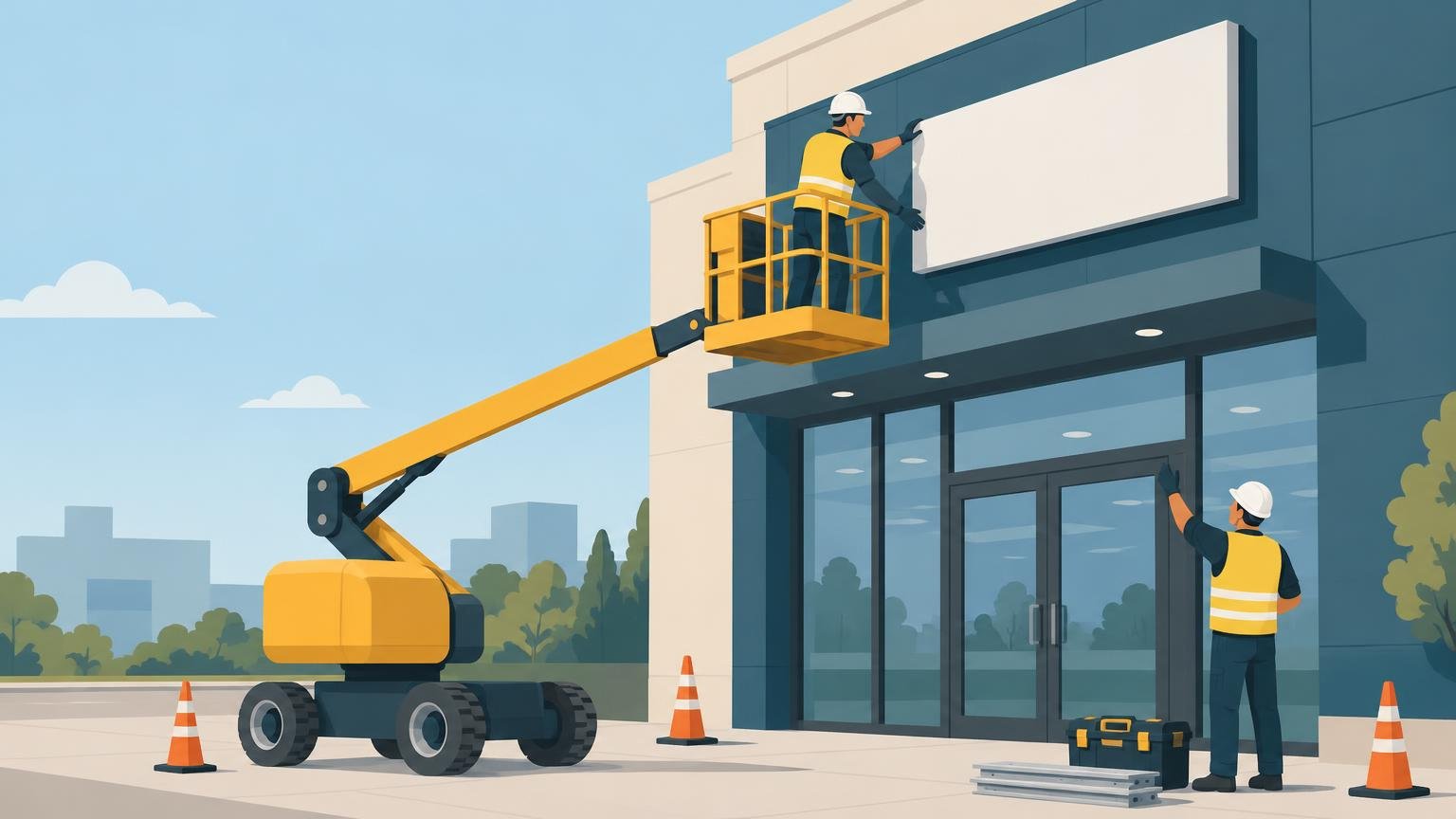
A commercial sign installer takes finished signs and graphics into the field and installs them correctly at customer locations. The job combines measurements, tools, teamwork, site communication and careful execution. You might install dimensional letters one day and apply interior graphics the next. Some assignments involve elevated work or electrical signs, but those duties require the appropriate training, authorization and procedures.
The short version: this is a good career to investigate if you like visible results, practical problem-solving and changing worksites. It is less suitable if you want predictable desk work or dislike weather, travel and physical tasks. Before accepting a position, ask how the employer trains new installers, assigns crews and authorizes workers for equipment and specialized duties.
What commercial sign installers actually install
Commercial sign installation covers more than the large illuminated name above a storefront. Depending on the shop, projects can include channel letters, dimensional lettering, monument and cabinet signs, ADA and wayfinding signs, interior branding, window graphics, fleet graphics, vinyl applications and large-format murals. Current job listings also mention reading installation drawings, using common measuring and fastening tools, photographing sites and reporting progress.
Installation and fabrication overlap, but they are not identical. Fabricators primarily build components in a shop; installers concentrate on getting those components positioned and completed at the site. A small company may train one person to do both. If the shop side interests you, compare this role with the work of a sign fabricator.
The variety is part of the appeal. It also means the title alone will not tell you what your week looks like. One installer may spend substantial time on architectural signage, while another concentrates on vinyl and fleet graphics. Read the employer’s project gallery and job description, then ask what percentage of the role involves each kind of work.
Planning starts before the crew unloads anything
A successful installation usually begins with information: approved drawings, dimensions, site conditions, access expectations and the correct components. Installers need to compare the work order with the location rather than treating the drawing as a suggestion. A measurement error discovered on the ground may be fixable. The same error discovered after work has begun can delay the crew, the customer and another trade.
Entry-level workers may help check parts, gather approved tools and materials, protect the work area or document existing site conditions. More experienced installers interpret plans, identify conflicts and communicate with an installation or project manager. The goal is not to improvise beyond your authority. It is to recognize when reality does not match the plan and raise the issue before it becomes an expensive mistake.
The work is built around a crew
Commercial installation is rarely a lone-worker adventure. Current listings describe coordination among installers, helpers, production employees, project managers, customers and other people at the jobsite. A lead installer may direct a helper or a two-person crew, although staffing varies with the employer and project.
That makes communication a job skill, not office decoration. You need to understand who is directing the work, repeat back important instructions, report damage or missing parts and keep others informed when conditions change. Customers may also see the installation crew as the face of the sign company. Being courteous, keeping the area orderly and explaining delays through the proper contact all matter.
A useful interview question is, “How is responsibility divided between the lead installer, helper and project manager?” The answer can reveal whether a beginner will receive structured supervision or simply be expected to figure everything out under pressure.
Travel, schedules and customer sites
Commercial installers may work at retail buildings, offices, construction sites and active facilities. The location can change from day to day. Weather may interrupt exterior work, customer operations can restrict scheduling, and some projects may require overtime or travel. The amount of regional driving, overnight work and schedule variation is employer-specific, so do not assume every installation position has the same travel burden.
Ask direct questions before accepting a job:
- What is the normal service area, and how often do crews stay overnight?
- Does the workday begin at the shop or at the customer site?
- How are travel time, overtime and schedule changes handled?
- How often does weather postpone work?
- What kinds of active jobsites does the company commonly enter?
For Tennessee job seekers, titles vary enough that searching only for “commercial sign installer” can hide opportunities. Try sign installer, field installer, graphics installer, installation technician and sign-installation helper. A broader look at sign, print and graphics careers in Chattanooga also shows how installation can connect with production and wide-format work.
Physical demands and weather are real parts of the decision
Expect standing, carrying materials, repeated tool use and outdoor exposure. Some positions involve climbing or work from approved elevated platforms. One current posting specifies regularly lifting at least 75 pounds, but that is one employer’s requirement rather than a universal standard for every sign-installer job.
Look for the actual physical requirements in each posting and discuss reasonable questions with the employer. Component size, crew practices and equipment can change the demands considerably. Being willing to ask for a coordinated lift is better judgment than treating every awkward object as a personal strength contest.
Safety training matters more than bravado
Commercial sign work can place crews around traffic, construction activity, electricity, overhead obstructions and elevated work. Beginners should learn through employer training, qualified supervision and approved procedures. Do not treat a general online video or a safety card as authorization to operate equipment.
For applicable aerial-lift work, OSHA says employers must ensure that workers operating the equipment have the required training or authorization. Training addresses subjects such as hazard recognition, inspections, proper operation, load limits and manufacturer requirements. OSHA identifies falls, tip-overs, falling objects, electric shock and overhead contact among the hazards. The OSHA aerial-lift guidance provides an official overview.
You may see “OSHA 10” or “OSHA 30” in job discussions. OSHA describes its 10-hour Outreach course as primarily intended for entry-level workers and the 30-hour course as more appropriate for workers with some safety responsibility. These voluntary hazard-awareness courses are not licenses or certifications, and an Outreach card does not replace training required under specific OSHA standards. OSHA’s Outreach Training Program explains that distinction.
Electrical sign work is another area where job descriptions differ. Some employers list electrical installation or connection experience as an additional desired skill. That does not make electrical work an automatic duty for every sign installer. Such work must stay within applicable licensing rules, employer authorization and job-specific training.
How to enter the field
There is no single entry route. Some companies seek experienced commercial installers. Others prefer related signage, construction or installation experience but offer training to motivated applicants. Helpful starting backgrounds can include sign-shop production, vinyl application, graphics finishing, construction-helper work and general installation. One Franklin, Tennessee posting described higher education as helpful but not required.
A realistic beginner plan is to build evidence that you can measure carefully, follow a work order, handle tools responsibly and communicate when something is wrong. You do not need to pretend that a classroom exercise was a customer installation.
- Search for helper, trainee, field technician and junior installer roles as well as installer positions.
- Prepare examples of careful practical work, such as measured layouts, supervised shop projects or clearly labeled graphics practice.
- Learn to read a basic sign drawing and identify dimensions, component labels and installation notes.
- Ask employers what training occurs before new hires use vehicles, powered equipment or elevated-access equipment.
- Bring a valid driving record or other requested documents when driving is part of the posted role.
Where manufacturer wrap training fits
Wrap and graphics courses can help if the employer installs fleet graphics, walls, windows or floors, but they are specialized preparation rather than universal sign-installer licenses. 3M lists a Nashville authorized location offering training and testing related to several graphics applications. Its three-day graphics-films course covers windows, walls, floors and fleet graphics, with optional testing for certain Preferred Installer designations. 3M also says that course is not designed to make an entry-level student test-ready and recommends its rigorous testing for experienced installers.
Avery Dennison separately lists beginner/intermediate commercial wrap training covering walls, floors, cut vinyl and commercial vans. Its Certified Wrap Installer exam is an advanced assessment; Avery recommends that applicants have experience installing at least 10 full wraps.
In other words, take training to develop the skills your target jobs actually use—not to collect a badge with a good-looking logo. Our guide to 3M and Avery vehicle-wrap training credentials explains the difference between instruction and advanced installer testing.
Pay data requires an honest label
Commercial sign installer is not a stand-alone BLS or O*NET occupation, so broad occupational figures should not be presented as the going rate for this exact job. O*NET’s “Construction and Related Workers, All Other” category reports a 2025 national median of $24 per hour and $49,910 per year, but O*NET warns that the category contains jobs with varied characteristics and does not provide sign-installer-specific task data. Treat those figures only as a labor-market proxy. O*NET’s occupation summary provides the full context.
BLS reports a 2025 national median wage of $42,670 for Helpers, Construction Trades, All Other. That can offer broad context for a helper or trainee pathway, but it is not a commercial-sign-installer wage. When comparing offers, use the employer’s stated range and ask how travel time, overtime, training periods and advancement affect total compensation.
Advancement: from reliable installer to crew leadership
A plausible progression is helper or shop support, installer completing assigned work from plans, experienced installer handling more complex projects, and then lead installer or crew lead. Current postings show that lead roles can add responsibility for helpers, customer communication and regional work. Some employers also request several years of experience or a particular driver’s license class, but those are employer requirements rather than universal career rules.
Beyond crew leadership, experienced installers may move toward installation management or project coordination. The strongest preparation is not just faster tool use. It is a record of accurate work, clear documentation, safe decisions and early communication when a site problem threatens the schedule.
What to ask before you judge the opportunity
Commercial installation is as much coordination and safe execution as fabrication skill. The best next step is to speak with a sign employer and ask how beginners become ready for real sites: Who supervises them? What training happens before equipment use? Which projects dominate the schedule? How much travel is normal? What demonstrates readiness for more responsibility?
Listen for concrete answers about supervised training, crew roles and authorization. A company that can explain how it develops installers is giving you more useful information than a job title ever will.
References
- 12-Point SignWorks Experienced Commercial Sign Installer in Franklin, TN | 1271896518 | Snagajob
- Sign Installer/Field Technician – Holly Springs, NC 27540 – Indeed.com
- Lead Sign Installer | Matthews Signs LLC
- Construction Laborers and Helpers : Occupational Outlook Handbook: : U.S. Bureau of Labor Statistics
- eTool : Scaffolding – Aerial Lifts | Occupational Safety and Health Administration
- 1926.453 – Aerial lifts. | Occupational Safety and Health Administration
- Outreach Training Program | Occupational Safety and Health Administration
- Sign Installer Jobs, Employment in Nashville, TN | Indeed
- Preferred Installer Training and Testing Dates | 3M US
- Trainings and Certification | Avery Dennison | Graphics
- CWI Certification Exam | Avery Dennison | Graphics
- 47-4099.00 – Construction and Related Workers, All Other