
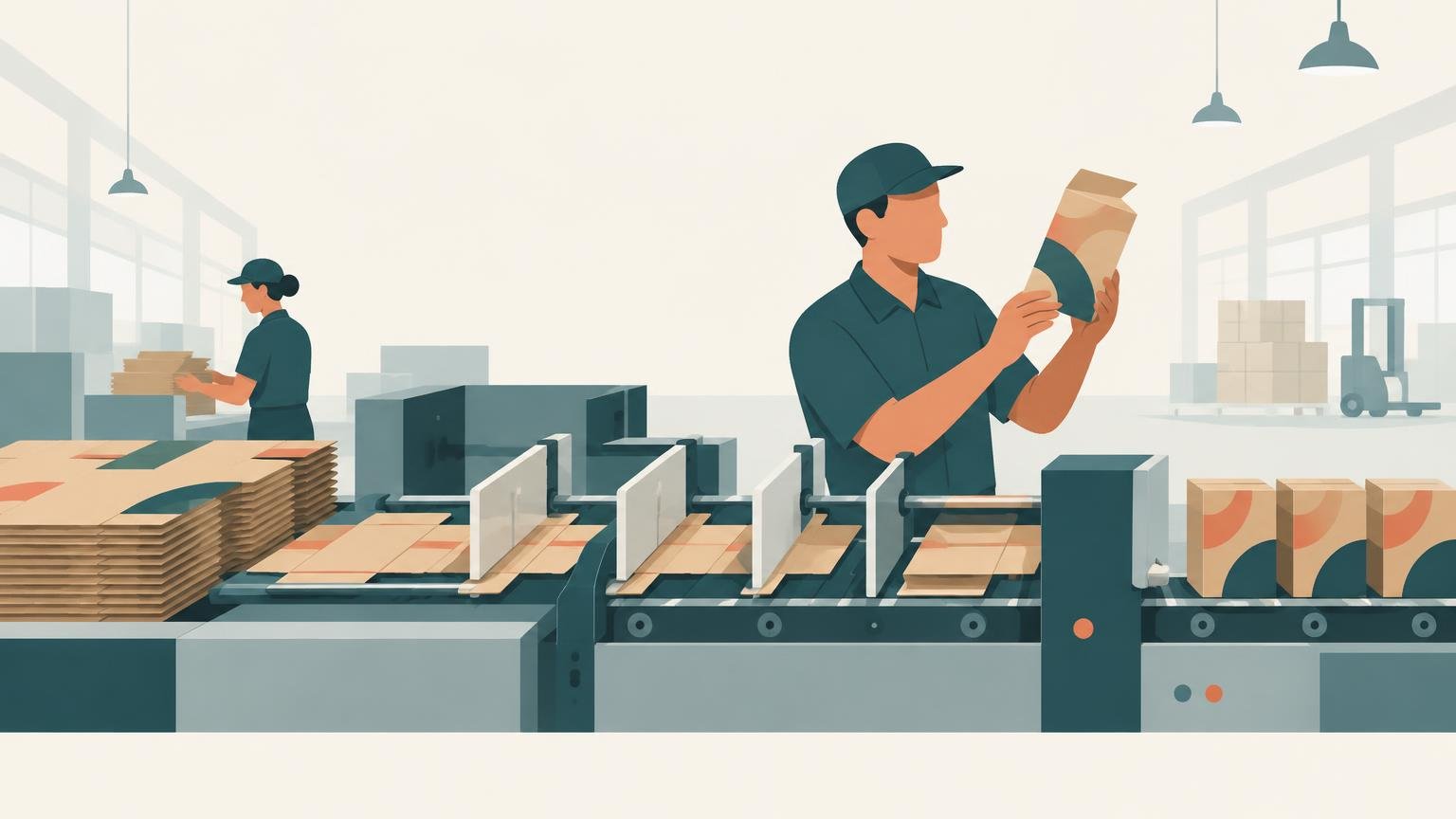
TLDR: A folder-gluer operator helps turn flat, printed blanks into finished cartons. The job combines production pace with careful attention to folds, adhesive placement, carton shape and repeated defects. A folder gluer operator career packaging path can suit someone who likes hands-on manufacturing but also wants responsibility for quality. Most skills are learned through supervised, employer-specific training.
The machine may run quickly, but the operator’s job is not simply to keep material moving. Operators and their crews follow the work order, compare finished pieces with an approved standard, inspect samples and report problems before the same defect appears across a long run. The strongest candidates are observant, dependable and willing to learn a plant’s procedures rather than assuming every machine works the same way.
What a folder-gluer produces
A folding carton often begins as paperboard printed with branding, instructions and product information. A die-cutting process cuts the carton’s outline and creates the lines where it is intended to fold. At that stage, the piece is still flat and is commonly called a blank.
Folding-gluing converts that blank into a structure that can be packed, shipped or prepared for filling. Depending on the carton design, the process may fold panels, apply adhesive in specified areas and compress the piece so the bond forms correctly. Folder-gluers are used for folding-carton and corrugated-board packaging, although materials, equipment and crew arrangements differ among plants.
This work is part of packaging converting: changing a printed sheet or board into a functional package. Packaging belongs to the wider print-production field, alongside the custom printing offered through Printiverse, but a carton adds a structural requirement. It must not only look right; it must also fold, open, close and hold its intended shape.
Printing, die-cutting and folding-gluing are different stages
| Stage | What happens | What reaches the next stage |
|---|---|---|
| Printing | Graphics and required information are placed on the board. | A printed sheet or web. |
| Die-cutting | The carton outline, openings and fold lines are formed. | A flat, shaped blank. |
| Folding-gluing | Specified panels are folded and joined. | A finished or partially finished carton ready for the next operation. |
Understanding those stages helps an operator trace a problem. A color or image problem may have started in printing. A poorly formed cut or fold line may come from die-cutting. An incorrect fold, bond or finished shape may appear during folding-gluing. Operators do not necessarily repair every issue themselves, but they need enough process awareness to stop, document or escalate a concern through the plant’s approved procedure.
The folder-gluer operator career in packaging starts with the job specification
Every production run should have a defined target. Depending on the employer, the controlling documents might be called a work order, job ticket, specification, setup record or quality plan. An approved sample may show how the completed carton is supposed to look and function.
Reading the job means confirming practical details such as the product identifier, carton style, material, quantity and required quality checks. The operator also needs to know which instructions control the run and where results must be recorded. Guessing from a previous job is risky because two blanks can look similar while requiring different folds or adhesive locations.
O*NET places titles such as Folder Machine Operator and Gluer Operator within the broader occupation Paper Goods Machine Setters, Operators, and Tenders, code 51-9196.00. Representative tasks include examining completed work against work orders, observing forming and glue flow, and monitoring production equipment. Readers can review the broader occupation through the O*NET occupational summary.
Why fold quality and glue placement matter
A small repeatable defect is the central quality challenge. One carton with a slightly incorrect fold may look minor. If that condition continues through thousands of pieces, it becomes a large production problem.
Fold quality can affect whether the carton reaches its intended shape, opens properly on later equipment or presents the printed panels correctly. Adhesive in the wrong location can create a weak bond, unwanted sticking or interference with another panel. The operator’s task is not to redesign the carton on the line. It is to recognize when production differs from the approved requirement and respond through established procedures.
Useful habits include comparing like points on successive samples, keeping samples identified, recording results clearly and communicating changes to the crew. Packaging plants may also have product-specific checks beyond appearance, especially when cartons must work with downstream filling or packing equipment.
Inspection is part of production, not an interruption
A folder-gluer crew may inspect pieces at startup and at defined intervals during a run. Checks can include the finished shape, fold position, visible adhesive problems, print orientation, damaged surfaces and whether required features are present. Exact checks and sampling schedules come from the employer’s quality system.
Some newer lines include automated systems for alignment, glue monitoring or defect detection. Manufacturer materials describe blank alignment, folding, gluing and inline quality-control functions, but those capabilities are specific to the equipment installed. They should not be assumed at every plant. Automated inspection also does not remove the human quality role: someone still has to understand an alert, examine samples, document the result and involve the appropriate person.
What the workday can feel like
Expect a production environment rather than a desk job. A current folder-gluer posting from Amcor illustrates requirements that can include prolonged standing, bending, reaching, lifting, communication and cooperation with a crew. Those are examples from one employer, not universal requirements. Applicants should ask each plant about its actual physical demands and available accommodations.
The work can be repetitive, but it is not mindless. You may watch similar cartons pass for a long period while remaining alert for a subtle change. Good operators notice patterns: a fold beginning to drift, marks appearing in the same place or finished cartons no longer stacking consistently. They communicate early instead of waiting for the problem to become obvious.
Teamwork matters because the line may involve operators, assistants, packers, material handlers, quality personnel and supervisors. A calm, specific report is more useful than “the machine is acting funny.” You should be able to identify what changed, when it started and which samples show the issue.
Training and realistic entry routes
The Bureau of Labor Statistics lists a high school diploma or equivalent as the typical entry-level education for the broad paper-goods machine occupation, with moderate-term on-the-job training as typical preparation. That does not mean every folder-gluer opening accepts a complete beginner. Employers may prefer prior manufacturing, finishing or packaging experience, especially when hiring someone expected to lead a line.
Possible starting roles include production helper, packer, machine assistant, finishing assistant or converting assistant. These jobs can teach you how work orders move through a plant, how acceptable product is identified and how crews communicate. They also let an employer see whether you are punctual, safety-minded and able to maintain attention during repetitive work.
Related hands-on work can build useful habits even when the product differs. For example, a sign fabrication career also requires workers to translate approved designs into physical output while respecting materials, specifications and safe procedures.
When applying, emphasize examples of following written instructions, inspecting repeated work, documenting results and escalating a problem appropriately. You do not need to pretend that unrelated equipment experience makes you a trained folder-gluer operator.
Wages and outlook require careful context
There is no single national wage series limited to folder-gluer operators. The closest federal category is the broader Paper Goods Machine Setters, Operators, and Tenders occupation. For that group, BLS reports a 2025 national median annual wage of $50,270 and projects employment to decline 4% from 2025 to 2035. These figures combine several paper-goods machine roles and should be treated as a general benchmark rather than a guaranteed folder-gluer wage.
CareerOneStop reports a 2025 Tennessee median of $22.56 per hour, or $46,920 annually, for the same broad occupation. Actual offers can vary with location, shift, experience, plant type and whether the position involves setup or leadership responsibilities. Compare job offers by their full terms, including schedule, overtime expectations, benefits, training and advancement—not just the headline hourly rate.
Safety depends on employer training and authorization
Folder-gluers contain moving parts and potential hazards such as ingoing nip points. OSHA explains that machine guarding addresses hazards including rotating parts and nip points. Its lockout/tagout requirements address unexpected startup or the release of stored energy during servicing and maintenance.
For a prospective operator, the practical rule is straightforward: use guards, follow the plant’s reporting process and perform only work for which you have been trained and authorized. Setup, adjustment, jam clearing, servicing and repair must follow the employer’s machine-specific procedures. An article or a video cannot replace supervised instruction, safeguards or required energy-control procedures.
Where folder-gluer experience may lead
With plant-specific experience, an employee may move toward operator, lead operator, converting lead, quality-focused work or production supervision. Progress usually depends on more than speed. Employers need people who can produce consistent work, document checks, communicate with other departments and help newer workers follow procedures.
Maintenance is a separate path that normally requires additional technical training and authorization. It should not be treated as an automatic extension of operating a line. If advancement matters to you, ask how the employer evaluates readiness and whether training is structured or informal. The broader principles in this guide to early-career advancement can help you plan the conversation.
Questions to ask a packaging employer
A job title alone will not tell you what a particular plant expects. Ask questions that reveal the products, training process, physical requirements and quality responsibilities.
- What types of cartons or packaging does this line produce?
- Is this an entry-level operator role, an assistant role or a lead position?
- How is supervised training organized, and how is readiness assessed?
- Which quality checks does the operator perform and document?
- What are the standing, lifting, reaching and repetitive-motion demands?
- What shift is assigned, and how often are overtime or schedule changes expected?
- Who handles setup, adjustments, jams and maintenance under plant procedures?
- What does a successful first 90 days look like?
- Can assistants progress to operator roles, and what skills are required?
- Where have experienced operators moved within the plant?
Listen for concrete answers. “We train people” is less useful than an explanation of who trains new hires, what stages they complete and how the employer decides they can take on more responsibility.
Is this work a good fit for you?
Packaging converting can be a good fit if you enjoy hands-on production, can stay attentive during repetitive work and take satisfaction in catching a small problem before it multiplies. It may be frustrating if you dislike standing, production schedules, repeated inspection or working within tightly defined procedures.
A practical next step is to search for folder-gluer assistant, converting assistant, finishing assistant and packaging production roles in your area. Compare the duties rather than relying on titles, then ask how supervised training leads to greater responsibility. The strongest beginner is not the person who claims to know every machine. It is the person who follows the specification, notices changes, communicates clearly and respects the line’s safety rules.
References
- Folding-gluing – Folder-gluers | BOBST
- 51-9196.00 – Paper Goods Machine Setters, Operators, and Tenders
- 51-9196.00 – Paper Goods Machine Setters, Operators, and Tenders
- Cosmetic and pharma packaging: why EXPERTFOLD 50/80/110 is key to box quality and compliance | BOBST
- FolderGluer Operator | Amcor
- Data for Occupations Not Covered in Detail : Occupational Outlook Handbook: : U.S. Bureau of Labor Statistics
- Salary Finder | CareerOneStop
- eTool : Machine Guarding – Introduction – Additional Safety Considerations | Occupational Safety and Health Administration
- www.osha.gov