
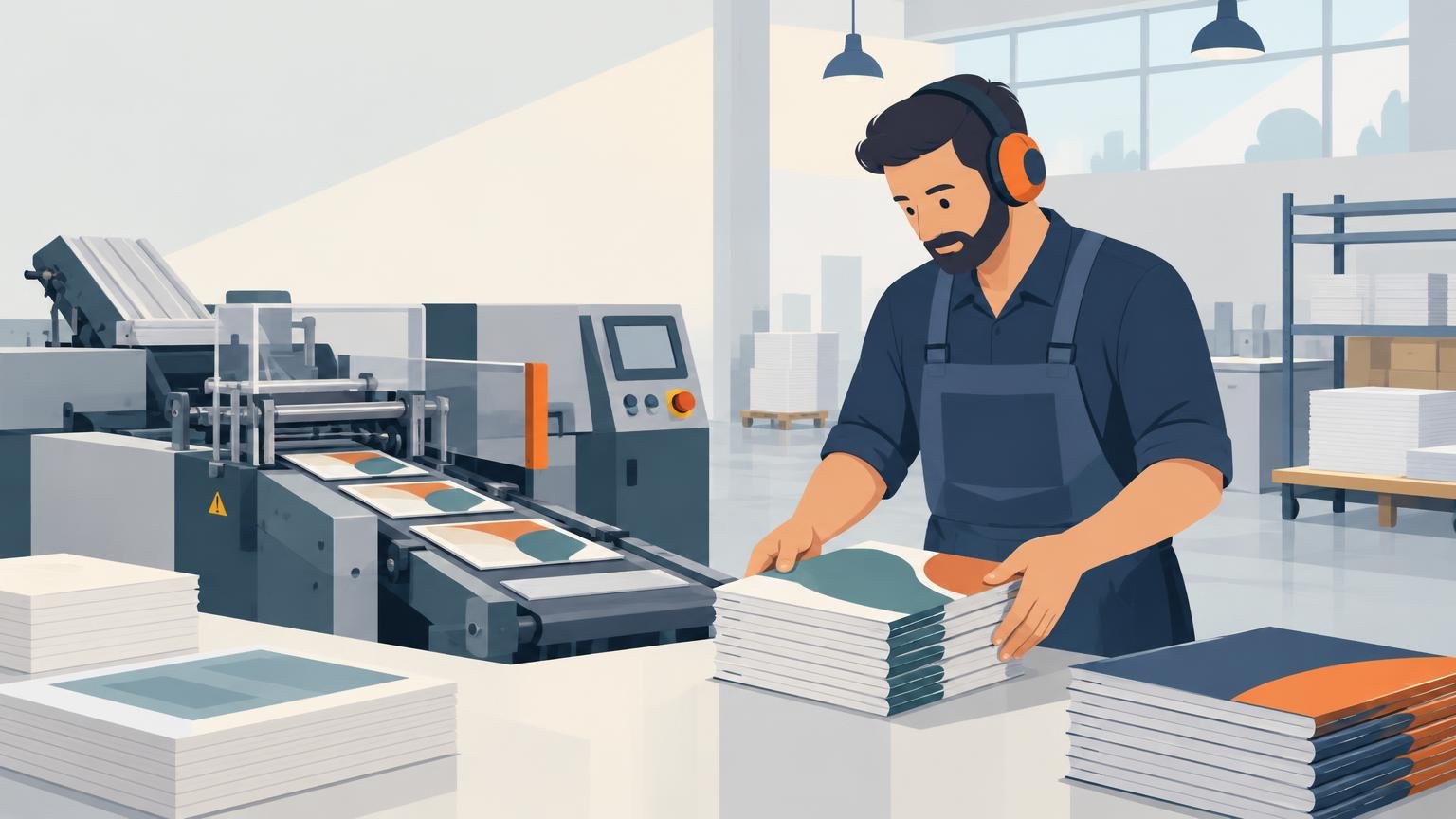
TLDR: If you are wondering what does a bindery finishing operator do, the short answer is that this worker turns printed sheets into completed products. A shift may include reviewing work orders, staging materials, preparing an assigned machine, monitoring output, inspecting finished pieces, recording counts and packing the job. Entry-level workers often begin with hand finishing, material handling or one supervised machine assignment before learning more complicated setups.
Finishing is where flat print becomes something a customer can use: a trimmed postcard, folded brochure, stapled booklet, bound manual, laminated sign or packaged order. The work rewards people who like precise measurements, repeatable processes and a visible result at the end of the shift. It can also provide a practical route into skilled print production without requiring a four-year degree.
What does a bindery finishing operator do during a shift?
Most jobs move through the same broad sequence: understand the order, stage the materials, prepare the assigned station, run and inspect the work, then pack or hand off the finished product. O*NET places the occupation under Print Binding and Finishing Workers, SOC 51-5113.00. Its task examples include reading work orders, adjusting equipment, trimming or binding products, inspecting samples, maintaining production records and packing completed work. The O*NET occupation profile provides a useful national description of the role.
At the beginning of a job, the operator checks the work order or job ticket. This document tells the department what product is being made, how many are needed and which finishing steps apply. The operator may confirm that the correct printed sheets, covers, cartons or other materials have reached the station. Catching a mismatch here is far better than discovering it after an entire order has been folded or bound incorrectly.
During the run, the operator watches both the equipment and the product. That can mean checking alignment, fold sequence, trim position, page order, binding security, surface condition and completed quantity. The goal is not merely to keep a machine moving. It is to produce acceptable pieces consistently and stop or report a problem before it grows.
At the end, the operator records production information, separates rejected pieces, packs acceptable work and sends it to the next department or shipping. Good handoffs matter. A perfectly folded job can still become a problem if the count is wrong, cartons are mislabeled or the next worker does not know that part of the order needs attention.
The main processes in a finishing department
A small print shop may ask one person to handle several processes. A larger plant may assign operators to particular machines or production lines. No single job necessarily includes every type of finishing, but these are common areas to recognize when reading postings:
| Process | What it accomplishes | Typical operator focus |
|---|---|---|
| Cutting and trimming | Brings printed sheets or stacks to the required finished size | Measurements, clean edges, orientation and correct counts |
| Folding | Turns flat sheets into brochures, signatures, mail pieces or other folded products | Fold sequence, alignment, cracking, wrinkles and consistency |
| Collating or gathering | Places pages, sections or components in the required order | Sequence, missing pieces, duplicates and completed sets |
| Stitching | Fastens sheets or sections, often to create booklets | Page order, secure fastening, alignment and trimming |
| Perfect binding | Attaches a cover to a prepared book block using an adhesive-binding process | Page integrity, cover alignment and binding quality |
| Drilling | Creates holes for binders, tags or other uses | Position, alignment and clean output |
| Laminating | Adds a protective or decorative film to printed material | Surface appearance, adhesion and handling |
| Die-cutting | Cuts or creases a printed piece into a particular shape | Registration, clean cuts and separation of usable pieces |
| Packing | Prepares completed work for storage, delivery or the next department | Counts, labels, protection and accurate handoff |
Looking at the variety of brochures, books, cards, signs and other products available through a broad print provider such as Printiverse can make the department’s purpose easier to picture: the operator helps turn printed material into those usable formats. In an actual shop, the available processes depend on its customers, equipment and production volume.
What “operator” means at different experience levels
The word operator can hide a large difference in responsibility. A helper or trainee might move stock, perform hand assembly, pack jobs, assist an experienced operator and learn one station under supervision. A developing operator may run repeat work on an assigned machine and make routine quality checks. An experienced operator may be expected to complete independent setups, document output, identify production problems and coordinate helpers.
A Tennessee example shows the upper end of that range. A Jobs4TN posting for an RRD Bindery Operator 2 in Smyrna listed cutters, folders, collators, stitchers, drills and gluing or binding equipment. It also described safety checks, quality monitoring, crew direction and mentoring. Those leadership and independent-operation duties are evidence of an experienced position, not a universal requirement for someone entering the trade.
This distinction is important when applying. A posting that asks for independent setup, troubleshooting and crew direction is not the same opportunity as one advertising a helper, trainee or machine-assistant position. Do not reject the whole occupation because an advanced posting looks intimidating. Search for the level that matches what you can safely demonstrate today.
Accuracy is a core production skill
Finishing operators work with physical products, but much of their value comes from careful thinking. They must connect the instructions on a work order with what is happening at the station. Basic math and measurement comfort help with counts, dimensions, spoilage records and packing quantities. Clear documentation helps the next shift understand what has already been completed.
Quality control usually means examining samples throughout the job rather than waiting until the end. Depending on the product, the operator may look for crooked folds, incorrect page order, loose pages, marks, uneven trimming, damaged surfaces or incorrect quantities. O*NET specifically includes inspecting samples for defects and monitoring equipment among the occupation’s tasks.
A useful interview example does not need to come from a commercial bindery. You might describe a school, warehouse, food-service or craft project where you followed written specifications, counted accurately, kept materials organized and caught a mistake before completion. The employer is listening for reliable habits that can transfer to production.
The physical and work-environment realities
Bindery work commonly involves standing, frequent hand use, repetitive paper handling and coordination with other production workers. Depending on the station, a worker may also bend, reach, move materials or load supplies. Printing environments can be noisy, and the job may require employer-specified personal protective equipment. O*NET work-context information and OSHA’s printing-industry guidance support treating hand use, material handling, noise and safe work practices as central parts of the environment.
The exact demands are facility-specific. One employer may use mechanical material-handling equipment and team lifts, while another may expect more manual movement. Shifts, overtime and weekend work also vary. If a posting does not clearly state its lifting, standing or schedule expectations, ask before accepting the job rather than assuming every bindery operates the same way.
Production support can also differ by shift. An overnight role may provide valuable equipment time but have fewer trainers or maintenance staff immediately available. The checklist in this guide to night-shift printing jobs can help you compare the complete schedule and support structure, not just the shift label.
Safety depends on training and disciplined habits
Cutting, folding, stitching and binding equipment should be learned through supervised employer training. A new worker’s job is to follow the approved procedure, use required safeguards and personal protective equipment, keep the area orderly, and report unusual sounds, jams, damage or unsafe conditions. Never improvise around a guard or reach into equipment because a deadline feels urgent.
Good operators are not the people who take the most risks. They are the people who can produce repeatable work without creating danger for themselves or the crew. OSHA’s printing-industry resources emphasize recognizing hazards and using appropriate controls in printing operations. OSHA’s printing-industry eTool is a useful overview, although the employer remains responsible for training workers on the facility’s actual equipment and procedures.
How to enter the field and build more valuable skills
BLS classifies Print Binding and Finishing Workers as typically requiring a high school diploma or equivalent, no related work experience and moderate-term on-the-job training. Its national data report a May 2025 median annual wage of $42,290. This is a national occupational figure, not a promised starting wage or a Tennessee-specific rate. BLS also projects national employment in the occupation to decline 17% from 2025 to 2035, making transferable production skills especially valuable.
The outlook does not mean there will be no openings. Workers retire, change occupations or leave particular employers, and shops still need people who can finish the products they sell. A Tennessee education document using Jobs4TN data retrieved in February 2024 projected the state occupation from 790 workers in 2020 to 670 in 2030 while estimating 70 annual openings. Because that is an older 2020–2030 projection series, treat it as dated context rather than a current hiring forecast.
For an entry-level applicant, the strongest preparation is practical: show up reliably, read instructions carefully, handle materials without damaging them, communicate problems early and demonstrate comfort with measurements and counts. O*NET places the occupation in Job Zone 1–2 and indicates that preparation can range from a few days to as much as a year of on-the-job training, depending on the position. It also lists apprenticeship titles such as bindery worker, bindery machine setter, bookbinder and folding machine operator.
A bindery operator is therefore not always the same as a traditional bookbinder. Bookbinding is one part of the broader occupation. Modern finishing departments may produce direct mail, folders, packaging components, signs or short-run promotional work in addition to books and booklets.
A realistic advancement path
Advancement often comes from becoming dependable on one process and then learning adjacent work. A possible progression is helper, machine assistant, operator on repeat jobs, independent operator, multi-machine operator and lead. Some workers move toward production scheduling, quality control or supervision. Others cross-train in press or prepress work. These are possible routes, not guaranteed promotions.
- Learn to read job tickets and identify missing information before work begins.
- Build reliable measurement, counting and production-record habits.
- Understand the quality checks for one assigned process.
- Learn safe material staging and orderly handoffs.
- Ask to cross-train on another finishing process after demonstrating consistency.
- Document the machines, products and responsibilities you can handle safely.
- Learn how delays, spoilage and rework affect the rest of the production schedule.
Machine knowledge can become increasingly specialized. Heidelberg, for example, offers advanced folding instruction intended for experienced commercial bindery operators, covering equipment components, safety, operation and maintenance. That is a useful illustration of how training can continue after entry, although manufacturer instruction does not replace a shop’s equipment-specific supervision.
If you are comparing finishing with another production route, the wide-format printer operator career guide shows how a different print-floor role combines equipment monitoring, media checks and workflow responsibility.
How to evaluate a bindery job posting
Do not judge an opening by its title alone. “Bindery operator” might describe a supervised beginner position in one shop and an experienced crew-lead role in another. Read the duties and ask questions that reveal the actual level.
- Is the position a helper, trainee, assistant or independent operator role?
- Which machine or process would you learn first?
- How much of the shift is hand finishing, packing or material movement?
- Who provides training, and how is readiness to work independently evaluated?
- What standing, lifting, reaching or repetitive-motion demands apply?
- Which safeguards and personal protective equipment are required?
- Does the schedule include overtime, weekends or rotating shifts?
- Will you remain on one station or have a path to cross-training?
- Does advancement depend on learning additional machines, leading a crew or meeting documented quality goals?
- Who handles equipment faults and maintenance beyond routine operator responsibilities?
Listen for a specific training plan. “You will shadow an operator and complete supervised sign-offs on one machine” is more informative than “You will learn as you go.” Also look for a clear boundary between routine operator care and maintenance work that should go to qualified personnel.
Is bindery finishing a good career fit?
Finishing can suit you if you enjoy precise, repeatable work and like seeing a physical product take shape. It may be less appealing if you strongly dislike standing, production noise, repeated hand tasks or working to scheduled job counts. The best operators combine patience with urgency: they keep work moving, but they do not ignore a defect or safety concern to gain a few minutes.
Your practical next step is to compare three local postings by training level, assigned equipment, physical demands, schedule and cross-training opportunities. Favor a position that clearly explains how beginners are trained and which skills they can build. Finishing rewards precision, repeatability and tangible output—and for someone willing to learn more than one process, it can be a strong production career path in its own right.
References
- 51-5113.00 – Print Binding and Finishing Workers
- JOBS4TN.GOV – Job Details
- eTools : Printing Industry – Lithography | Occupational Safety and Health Administration
- Data for Occupations Not Covered in Detail : Occupational Outlook Handbook: : U.S. Bureau of Labor Statistics
- www.tn.gov
- Operator training | HEIDELBERG USA