
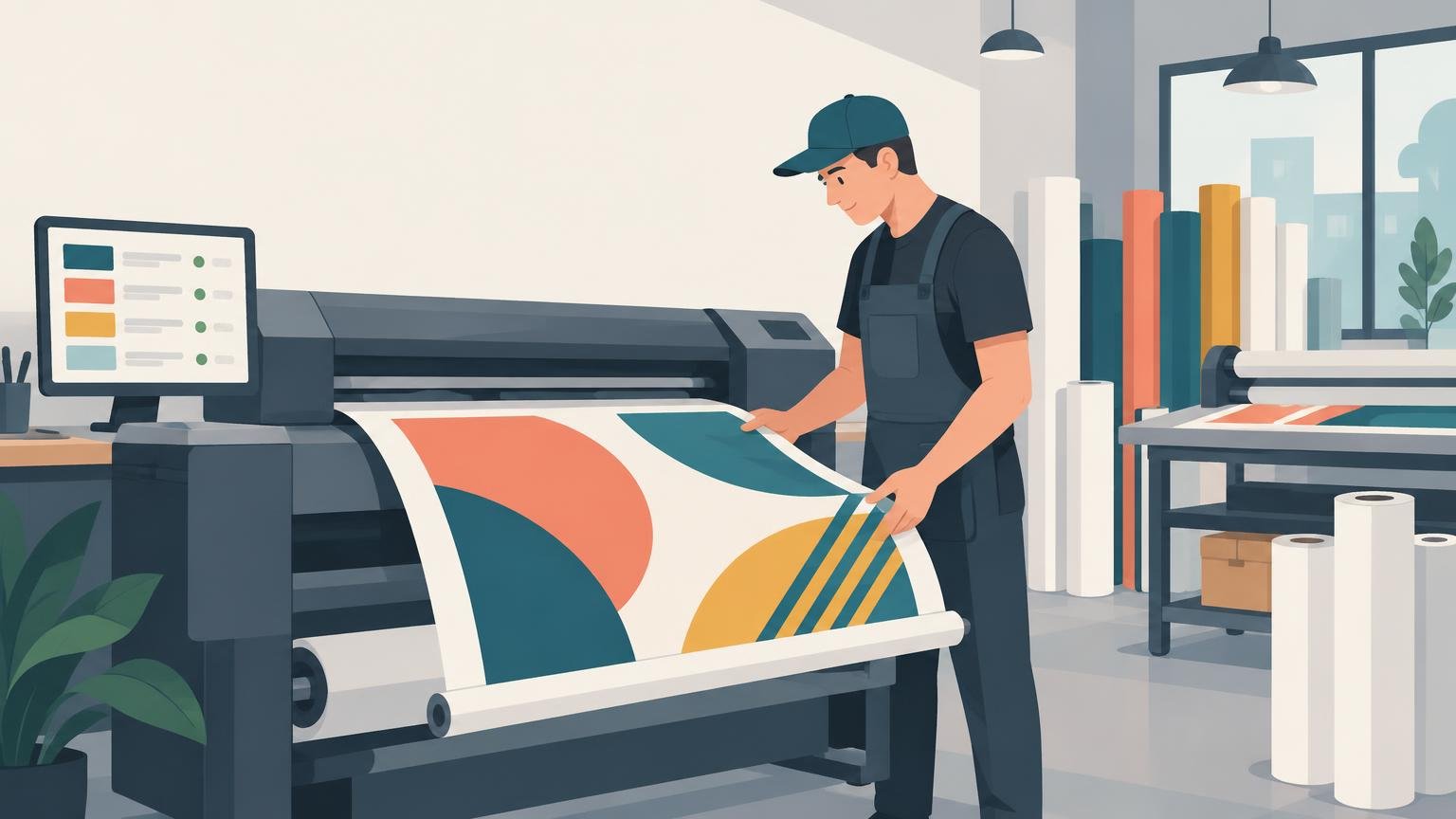
TLDR: A wide format printer operator sign shop career is a practical option for someone who likes visual work, organized production and catching small errors before they become expensive ones. The operator takes an approved file, confirms the job settings and material, manages the RIP queue, watches the print, checks its quality and prepares it for cutting, lamination or another finishing step. Beginners can enter through operator-trainee, production-assistant or finishing roles without first becoming vehicle-wrap installers.
The job sits between the computer file and the finishing table. Pressing “print” is one small part of it. A dependable operator knows which job should run, which roll or sheet belongs with it, what a good print should look like and when to stop and ask a question. That combination of care and production awareness is the foundation of a wide format printer operator sign shop career.
What a wide-format printer operator produces
Wide-format equipment creates graphics larger than an ordinary office or desktop printer can handle. Depending on the shop, the output might include banners, decals, window graphics, wall graphics, display panels, posters, signs or printed film that will later become part of a vehicle graphic. Some shops specialize in one market, while others produce a broad mix of commercial graphics.
The exact division of work also varies. One operator may print, laminate and cut a job from start to finish. In a larger operation, the operator may stage the completed print for a separate finishing or installation team. If you want to understand how physical sign construction differs from print operation, see this beginner’s guide to sign fabrication. You can also explore the wider commercial printing world to see how sign production fits within a much broader industry.
A normal job follows a sequence: read the job ticket, confirm the approved file, verify the material and settings, place the job in the correct queue, load or confirm the media, print a proof or production piece, inspect the output, label it and move it to the next stage. O*NET’s broader Printing Press Operators profile lists comparable duties such as reviewing job orders, checking stock and ink against specifications, pulling proofs, inspecting samples and operating auxiliary cutting or laminating equipment. Wide-format sign work is a specialty within that larger production picture, so the occupation profile is a useful proxy rather than an exact description of every sign-shop job. Review the O*NET Printing Press Operators profile for the broader task list.
RIP and queue awareness: more than clicking Print
RIP stands for raster image processor. In practical terms, RIP software translates the design and job information into data the printer can use. A print server may also let the shop prioritize, combine, reroute or adjust jobs before production.
An entry-level operator does not need to arrive knowing every RIP package. Software and screen layouts differ among shops. You do need to understand the questions the queue is answering:
- Is this the correct and most recent file?
- Which printer is assigned to the job?
- What material and media profile does the ticket call for?
- How many copies are required?
- What finished size, orientation and cutting information apply?
- Is this job ready to run, or is approval still missing?
- Does another job have priority because of its deadline or finishing schedule?
Queue awareness matters because an incorrect setting can waste an entire roll rather than one sheet. The strongest beginner habit is simple: pause when the ticket, file name, material label and RIP setting do not agree. Asking one clear question is better than confidently producing twenty feet of the wrong graphic.
Learn to identify media without guessing
A sign shop may stock rolls of banner material, adhesive vinyl, specialty films, paper and other printable media, along with rigid sheets for compatible equipment. Similar-looking rolls may have different adhesives, finishes, liners or intended uses. The job ticket and the shop’s material labels—not appearance alone—should determine what gets loaded.
A new operator should learn the shop’s identification system. That may include product codes, roll labels, storage locations, width markings and rules for recording partial rolls. You should also notice obvious handling problems such as damaged edges, dirt, moisture exposure, wrinkles or a roll loaded in the wrong direction. The goal is not to memorize an entire supplier catalog on day one. It is to match the material to the production instructions and recognize when something needs confirmation.
Print-quality checks that protect the next step
Inspection should happen early enough to prevent repeated defects. Operators commonly pull a proof or examine the beginning of a run before committing more material. O*NET includes pulling proofs and inspecting samples during production among the broader occupation’s reported tasks.
Use a repeatable check rather than giving the print a quick glance from across the room. Before releasing a job, look for:
- The correct customer, file, version and quantity
- Readable, sharp text and expected image detail
- Color that matches the approved target or shop process
- Banding, streaking, missing areas or other repeated print defects
- Skew, wrinkles, scratches, smudges or contamination
- Correct orientation and enough space for trimming or finishing
- Labels or notes needed by the laminator, cutter, fabricator or installer
Color checking does not mean trusting your memory of what blue looked like yesterday. Follow the shop’s proof, approved sample and color-management procedure. Lighting, material and finish can affect appearance, so a questionable result should be compared under the shop’s normal inspection conditions and escalated when necessary.
Handoff to lamination, cutting and installation
A clean print can still become a failed job if the handoff is careless. The next worker needs to know what the piece is, which side is the top, whether it requires lamination, how it will be cut and whether any special instructions apply. Keep finished graphics clean, supported and clearly identified.
Some entry-level postings combine printing with laminating, trimming, vinyl cutting or general production assistance. Related Tennessee searches use titles and phrases such as print production, wide-format print or signage, production assistant, laminating and vinyl cutting. Listings change quickly, so treat these as search terms rather than evidence that every employer combines the same duties.
Installation is a separate skill set even when one business handles both production and installation. Vehicle and architectural graphics must be applied using the employer’s supervised process. You do not need to present yourself as an installer merely because you want to operate a wide-format printer.
What maintenance is appropriate for a beginner?
Expect to learn routine equipment care, but learn it on the shop’s machine and under supervision. Appropriate beginner responsibilities may include following the approved startup or shutdown checklist, keeping the work area clean, checking consumable status, observing machine alerts and reporting an unusual sound, smell or print result.
Do not improvise repairs, bypass guards or copy a procedure from an unrelated machine. Printers use different ink systems, cleaning routines and service requirements. Your job as a beginner is to follow the trained procedure, document the problem clearly and know when to stop the equipment and call an experienced operator or authorized technician.
Skills to practice before applying
You can build useful habits even if you do not have access to production equipment. Focus on the parts of the job that transfer between shops:
- Read a sample job ticket and identify the file, size, quantity, material, finish and deadline.
- Practice accurate measurement and basic unit conversion without rushing.
- Organize digital files with clear names, versions and folders.
- Compare similar materials by label, intended use and finish rather than appearance alone.
- Inspect printed samples closely and describe defects in plain language.
- Become comfortable with basic design-file concepts such as page size, orientation, bleed and linked images.
- Practice giving a concise handoff: job name, quantity, status, next step and any issue that needs attention.
- Build the habit of asking before waste occurs.
A small interview portfolio can help even when the role is production-focused. Bring three or four examples that show you can follow a specification, organize files and inspect work. A mock job ticket paired with a finished poster, a defect-check worksheet or a file-version example can demonstrate production thinking without pretending that you have operated equipment you have never used.
A realistic entry route into a sign shop
The broader O*NET profile places Printing Press Operators in Job Zones 1–2. It says preparation can range from a few days to as much as one year of on-the-job training and that a high school diploma or GED is usually required. That does not guarantee the requirements of a particular wide-format position, but it supports looking for supervised entry routes rather than assuming a four-year degree is mandatory.
Search beyond one title. Try wide-format printer operator, digital print operator, sign production assistant, print production specialist, graphics production, finishing assistant, laminator operator and vinyl production. Read the duties carefully: two employers can use the same title for different combinations of printing, design, finishing, fabrication and installation.
For Tennessee students, the state CTE guide includes Digital Arts & Design and Audio/Visual Production programs of study, with possible options such as practicum, dual enrollment and work-based learning. Availability and equipment depend on the local school, so ask specifically whether a program offers print-production experience, employer placements or related design-file training.
Another practical route is to enter through finishing or production assistance. Loading materials, labeling work, trimming simple jobs and preparing handoffs can teach you how the shop moves work before you take responsibility for a print queue. If you are still deciding whether the broader field fits you, review printing as a career path.
Do you need 3M or Avery Dennison training?
Not usually for an entry-level print-operator application unless an employer specifically requests it. The supplied 3M information separates hands-on graphics-film installation training and Preferred Installer testing from general production work. Its training topics include walls, windows, floors, fleet graphics, color change and vehicle wraps. Avery Dennison likewise describes graphics and wrap-installation training along with a Certified Wrap Installer path.
Those programs may make sense if you intend to move toward wrap or graphics installation. They should not be presented as universal wide-format operator credentials. For a first production role, careful job-ticket reading, media identification, visual inspection and reliable handoffs are usually more directly connected to the work described here.
Your practical next step
Review five current sign or print-production listings in your area using several of the title variations above. Make a two-column checklist: duties you can already demonstrate and duties that require supervised training. Then prepare one example showing how you would read a job ticket, verify the file and material, inspect the output and communicate the handoff.
A wide-format operator is the careful link between the approved file and the finishing table. If you can stay organized, handle media carefully, notice visual problems and ask questions before material is wasted, you already understand the habits that matter most. The machine-specific procedures can be learned under supervision; dependable production judgment is the foundation you should start building now.
References
- 51-5112.00 – Printing Press Operators
- HP Scitex FB950 – Workflow overview | HP® Support
- Print Jobs, Employment in Germantown, TN | Indeed
- TENNESSEECTE2024-25 CTE Programs of StudyTennessee’s career and technical education (CTE) programs of study are meant to provide a relevant framework of
- Preferred Installer Training and Testing Dates | 3M US
- Trainings and Certification | Avery Dennison | Graphics