
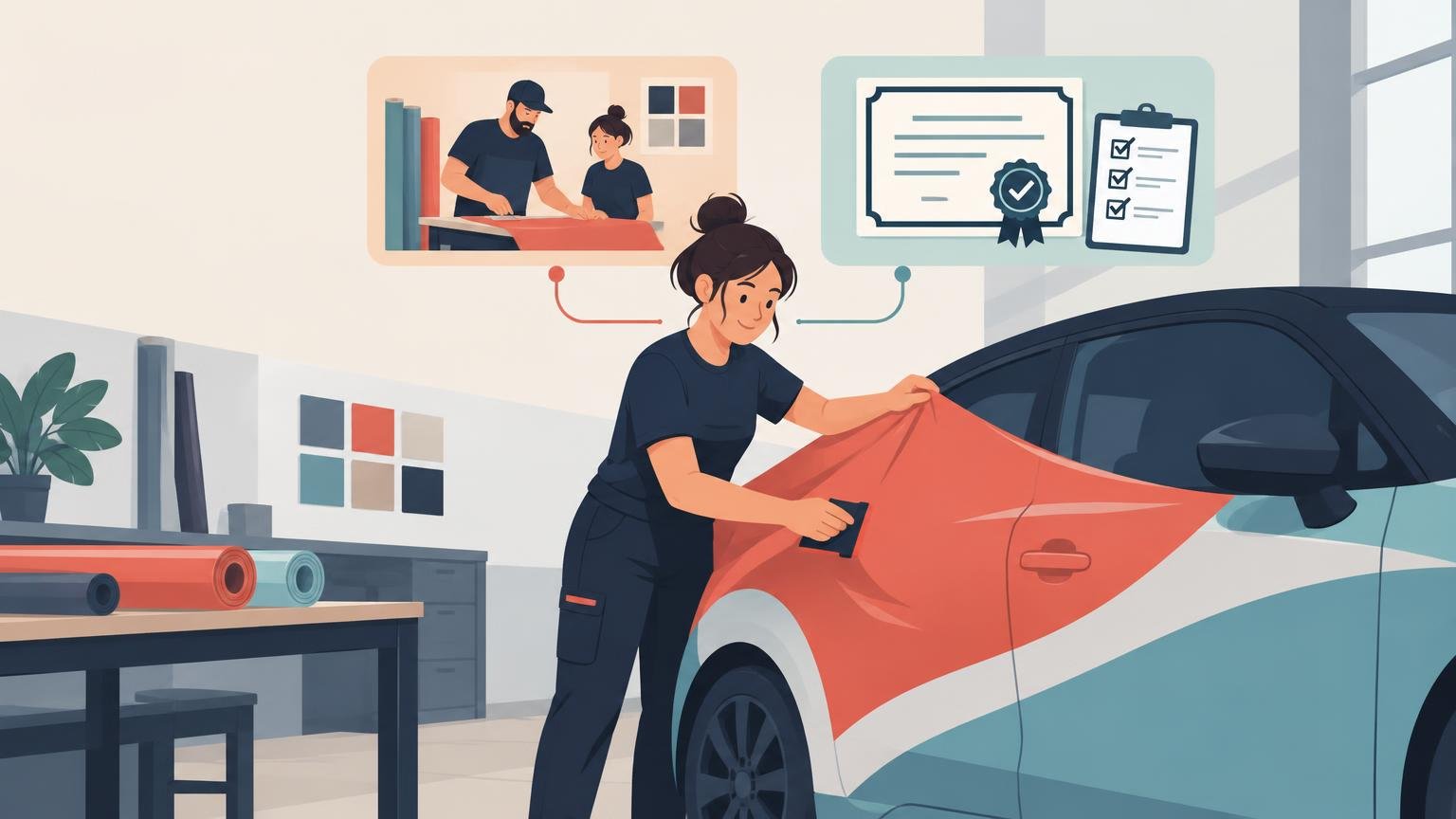
TLDR: Both manufacturers offer useful hands-on instruction, but taking a class is not the same as passing a formal installer assessment. In a 3M vs Avery wrap training certification career decision, beginners should choose an appropriately leveled course, get supervised installation practice and build an honest portfolio before treating advanced testing as the next step. A credential can strengthen your résumé; it cannot replace clean work, steady production habits and experience.
Vehicle wrapping is careful production work, not simply sticking a large sheet of vinyl to a car. An installer cleans and prepares surfaces, studies panel shapes, positions graphics, manages material around curves and recesses, trims safely, finishes edges and inspects the result. Commercial shops may also expect help with decals, signs, printed graphics and other finishing tasks. That everyday work is the right starting point for comparing manufacturer programs.
Why manufacturer wrap training exists
Manufacturer training gives installers a structured place to learn techniques, handle a specific material system and receive instructor feedback. That is valuable because a mistake on a practice panel can become a lesson, while the same mistake on a customer vehicle can become damaged material, rework and a late delivery.
Training and experience still do different jobs. A short course can organize what you need to practice, correct obvious habits and introduce unfamiliar applications. Repeated supervised work teaches you to maintain quality when the vehicle, design, deadline and material are less cooperative than the classroom exercise.
Formal testing adds another layer. Instead of teaching a technique and allowing time to practice it, an assessment asks you to demonstrate defined skills under test conditions. Keep four forms of evidence separate when planning your career:
- Course attendance shows that you pursued structured instruction.
- A passed manufacturer assessment shows that you met that program’s testing requirements at that time.
- A portfolio shows the visible quality and range of work you can document.
- Supervised job experience shows that you can contribute safely and consistently in a production environment.
How the current 3M route is structured
3M separates hands-on graphics training from Preferred Installer accreditation testing. Its listed training routes include graphics installation for applications such as fleet graphics, windows, walls and floors, along with vehicle color-change training. Training and the applicable Preferred Installer test are separate decisions rather than one automatic credential path. Review 3M’s current installer training and testing listings before choosing a date or location.
This distinction matters for beginners. 3M says its three-day graphics course is not intended to give an entry-level installer all the skill needed to pass its rigorous Preferred Installer tests. It also advises vehicle color-change students with less than one year of industry experience not to attempt that test yet. That is a useful reality check: the class can be a beginning even when the test is not yet an appropriate goal.
Choose the route according to the work you want to do. Color-change work concentrates on changing the appearance of a vehicle with wrap film. Fleet and commercial graphics work can involve printed branding, panel alignment and repeatable installation across working vehicles. A learner targeting sign and fleet shops should not assume that every attractive color-change exercise covers the production skills used in commercial graphics.
Tennessee learners have a potentially convenient option to investigate. 3M lists School of Wrap in Nashville as an authorized training and testing location, with graphics and fleet, vehicle color-change, automotive window film, paint-protection film and related testing offerings shown on the supplied page. Dates, course availability and prices still need to be confirmed directly for the session you want.
How the current Avery Dennison route is structured
Avery Dennison also separates instruction by level from formal assessment. It lists Commercial Wrap Training and Supreme Wrapping Film Training as beginner or intermediate options, while Advanced Wrap Training and the Certified Wrap Installer, or CWI, exam are designated for advanced or expert participants. Avery’s FAQ says prior experience is not required for its Full Print Digital or Supreme Wrap classes.
The two-day Full Print Digital and Supreme Wrap courses include hands-on work, instructor time and basic tools, according to Avery. The Full Print Digital course covers applications involving cars, walls, windows and floors, while Supreme Wrap focuses on cars. Avery also says a roll of selected material is shipped after class, giving a learner material for further practice.
The CWI exam is a different proposition. Avery says it includes a written exam, a digital full-print hood installation, a color-change front fender, a digital full-print back door with window perforation and a cutting test. An unsuccessful candidate may retake the assessment once without another exam charge within one calendar year.
Avery recommends that CWI candidates have completed at least 10 full wraps and taken its Full Print Digital and Supreme Wrap training before attempting the exam. That recommendation makes the intended sequence clear: learn, practice complete installations and then test. The CWI should not be treated as a beginner class with a credential attached at the end.
| Question | 3M path | Avery Dennison path |
|---|---|---|
| Can a beginner take training? | Some training is available, but 3M explicitly warns that entry-level students should not expect a short course to prepare them for rigorous Preferred Installer testing. | Full Print Digital and Supreme Wrap classes do not require prior experience, according to Avery’s FAQ. |
| Is training the formal credential? | No. Hands-on training and Preferred Installer testing are separate. | No. Beginner and intermediate courses are separate from the advanced CWI exam. |
| When should testing enter the plan? | After relevant practice; 3M advises color-change students with less than one year of experience not to attempt that test yet. | After substantial practice; Avery recommends at least 10 full wraps and specified courses before CWI testing. |
| What should determine the route? | Whether your target work is color change, fleet graphics or another listed graphics application. | Whether you need introductory digital or color-change instruction, advanced training or the separate CWI assessment. |
What tuition does—and does not—tell you
Course price is only one part of the decision. On its 2026 schedule for the 3M Center in St. Paul, Minnesota, 3M lists $1,650 for a three-day Graphic Films Installation Training course. The same schedule lists $550 for each one-day Windows/Walls/Floors or Fleet Preferred Installer test. Those are St. Paul schedule prices, not Nashville or nationwide prices.
The supplied Avery pages do not establish one universal tuition figure, so it would be misleading to invent a direct price comparison. Request the current total for the specific class and location instead. Before registering with either program, confirm:
- The exact course name, level and applications covered
- Whether the fee is for instruction, formal testing or both
- Current tuition, deposits and cancellation or transfer terms
- What tools and materials are included or must be brought
- Travel, lodging, local transportation and missed-work costs
- Whether the desired test is offered at that location and date
- What happens if you do not pass and what a retest costs
- Any prerequisites, required identification or safety rules
A nearby class with a slightly higher fee can cost less overall than a distant class once flights, hotel nights and unpaid time are included. Compare total out-of-pocket cost, not just the registration number.
How employers may interpret the credentials
A manufacturer credential can signal initiative, familiarity with a material system and willingness to be assessed. Avery says CWI status can improve installer credibility and includes a listing in its installer finder. That describes a program benefit, not a guarantee of a job, promotion or pay increase.
Actual postings show why the credential is only part of the hiring decision. A supplied Allvan USA posting in La Vergne described 3M certification as preferred rather than required and said training might be available for the right person. It also emphasized preparation, graphics installation, production and finishing, safety, measurement and quality control. A Knoxville posting sought vehicle-graphics and sign-installation ability, vinyl weeding, printed-graphics finishing, attention to detail, time management and at least one year of preferred experience.
For a more experienced role, AZ Rag’s Knoxville careers page asks senior wrap and paint-protection-film applicants for at least three years of full- or partial-wrap experience, a portfolio, references addressing speed and rework, and a paid trial installation. See the experience and work-sample expectations in the posting. These are individual employer examples, not a survey of every wrap shop, but they reveal the practical questions behind a résumé: Can you produce clean work, control rework and maintain a useful pace?
Broader shop ability can help an entry-level applicant. Vehicle graphics often sit inside a sign or graphics business rather than a wrap-only operation. Learning how related production roles fit together can make you more useful, so it is worth understanding what a sign fabricator does as well as concentrating on vehicles.
Build a portfolio that proves the right things
A beginner portfolio does not need to pretend you have wrapped dozens of customer vehicles. It should make your current ability easy to judge. With the vehicle owner’s or employer’s permission, photograph inspected work in good light and label your contribution honestly.
- Show wide views and close-ups of edges, corners, seams and recesses.
- Include panel alignment or printed-graphic registration where relevant.
- Document surface preparation, small decals and finishing tasks, not only dramatic completed vehicles.
- State whether the work was a class exercise, personal practice or supervised customer job.
- For team projects, identify the panels or steps you completed.
- Include examples that passed an instructor’s or supervisor’s inspection when you have permission to say so.
- Do not hide rework, present another installer’s panels as yours or call unsupervised practice professional experience.
A hiring manager may also care about habits that photographs cannot capture: arriving prepared, protecting the vehicle, measuring accurately, using tools safely, following the approved process and asking for an inspection before a questionable edge becomes a comeback. References or supervised trial work can help demonstrate those habits.
Which route fits a beginner?
Choose based on the next skill gap, not the logo you would most like on your résumé. If you have never completed a wrap, an entry-level class is more sensible than an advanced certification exam. Avery’s Full Print Digital or Supreme Wrap options are explicitly open to students without prior experience. On the 3M side, choose training aligned with either graphics and fleet work or vehicle color change, then respect the manufacturer’s warning that a short course is not enough preparation for advanced testing.
After class, seek supervised work in a wrap, sign, fleet-graphics or large-format production shop. You may begin with preparation, weeding, masking, decals, flat panels and finishing before taking responsibility for difficult vehicle sections. That progression is not a demotion from the glamorous work. It is how you build the control and judgment that prevent expensive mistakes.
Pursue formal testing when your experience resembles the manufacturer’s guidance and your recent work is consistently clean under inspection. If your goal is a particular employer, ask which applications and credentials matter in that shop before paying for an exam. A fleet-graphics employer and a color-change studio may value different evidence even when both use vehicle film.
A practical next step for Tennessee learners
Start by collecting current dates and total costs for one appropriately leveled 3M and one Avery Dennison course. For 3M, check the listed Nashville option as well as other authorized locations. Ask each provider exactly what the class teaches, what you will install yourself and whether registration includes any formal assessment.
Then contact several Tennessee sign, wrap or fleet-graphics employers. Ask what they expect from an entry-level production or installation applicant and whether they provide supervised training. Use those answers to choose a course that supports an actual job route rather than pursuing a credential in isolation.
The strongest plan is straightforward: take structured training, practice under supervision, document clean work and test when you are ready. Manufacturer credentials can add credibility, but the career is built in the space between classes—one prepared surface, inspected edge and reliable production day at a time.
References
- Preferred Installer Training and Testing Dates | 3M US
- Trainings and Certification | Avery Dennison | Graphics
- FAQs | Avery Dennison | Graphics
- CWI Certification Exam | Avery Dennison | Graphics
- 3M Installer Training Registration Form Schedule 2026
- Allvan USA, LLC hiring Graphics Installer in La Vergne, TN | LinkedIn
- Vehicle Wrap Installer – Knoxville, TN 37923 – Indeed.com
- Careers | AZ Rag Installations & Print Services, LLC